
In a boost for the country's surveillance capabilities to monitor activities of both military warships and merchant shipping in the Indian Ocean Region (IOR), the 'Sindhu Netra' satellite developed by a team of young scientists from Defence Research and Development Organisation (DRDO) was successfully deployed in space on Sunday.

Preparations are in the final stages by the Chennai-headquartered space-tech startup Agnikul Cosmos for the maiden launch of India's first-ever private launchpad and the second rocket launch by a private sector player.
The BJP hit back accusing the Congress of drawing the issue into political arena.
Prime Minister Narendra Modi lauded the scientists saying, "with this successful launch, we will determine our own paths powered by our technology".
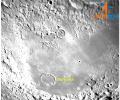
If any factor regarding the lander module appears unfavourable, then the landing will be shifted to August 27, said the Space Applications Centre-ISRO about Chandrayaan-3 on Monday.

A key feature of the satellite is providing mobile communication to India through multi beam coverage facility.

The Indian Space Research Organisation (ISRO) will perform the final manoeuvre on Saturday to inject Aditya-L1 spacecraft -- the first space-based Indian observatory to study the Sun -- into its final destination orbit, some 1.5 million kilometres from the Earth.
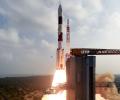
The Indian Space Research Organisation (ISRO) is all set to make its maiden commercial launch of 36 broadband communication satellites on board the space agency's heaviest rocket LVM3-M2, the countdown for which began early on Saturday at Sriharikota spaceport in Andhra Pradesh.

Aditya-L1 is the first Indian space-based observatory that will study the Sun from a halo orbit around the first Sun-Earth Lagrangian point (L1), which is located roughly 1.5 million km from the Earth.

Aditya L1, the first space based Indian mission to study the Sun underwent the second earth-bound manoeuvre successfully, during the early hours on Tuesday, Indian Space Research Organisation (ISRO) said.

A recap of events that occurred in India in the past week.

A round up of what's happening in the world of technology, gadgets and gizmos.

Former National Aeronautics and Space Administration (NASA) Official Mike Gold has said Chandrayaan-3's success is a triumph of Indian innovation, human capital and the capabilities that will take India even further.
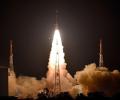
"I am really grateful to the entire ISRO family for having worked this hard and making IRNSS-1I a success," said the space centre's chief K Sivan.

Just over 22 minutes into the flight, the rocket put Astrosat into orbit at an altitude of 650 km above the earth

The first 'Pad Abort Test' demonstrated the safe recovery of the crew module in case of any exigency at the launch pad, the Indian Space Research Organisation said in a release.

Indian Space Research Organisation has built a supercomputer, which is to be India's fastest in terms of theoretical peak performance of 220 TeraFLOPS (220 Trillion Floating Point Operations per second).

The rocket is almost 49 meters high -- as much as a 17-floor building. It weighs 415 tons -- as much as the combined weight of 80 full grown elephants.
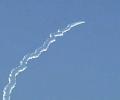
India on Monday successfully launched the first technology demonstrator of indigenously made Reusable Launch Vehicle, capable of launching satellites into orbit around earth and then re-enter the atmosphere, from Sriharikota in Andhra Pradesh.
.jpg)
India's maiden mission to Mars has traversed beyond the sphere of influence of Earth extending about 9,25,000 km in its 10-month long voyage to the red planet.

The polar satellite launch vehicle-C42 launch vehicle carrying the two satellites blasted off from the first launchpad at the Satish Dhawan Space Centre at 10.08 pm.

The space agency lines up GSLV-III and Chandrayan-II in 2017-18.

ISRO chairman S Somanath said the success gave the space agency "greater confidence," as the GSLV will be next deployed in the NISAR mission, a collaborative effort with the US' NASA.

Indian Space Research Organisation's Mars Orbiter, which was placed in inter-Mars trajectory in the early hours on Sunday, has crossed Moon's orbit and is travelling beyond Earth's natural satellite.

ISRO's first mission in 2023 and SSLV's sequel saw a strange coincidence--it was launched at 9.18 am, the same time its predecessor lifted off from the Satish Dhawan Space Centre here on August 7, 2022 but could not deliver due to orbit anomaly and flight path deviation.

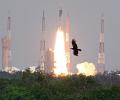
The 43.43 metre tall rocket lifted off at 5.28 pm from the second launch pad at the Satish Dhawan Space Centre in Sriharikota

'ISRO's style is a terrific example of being able to survive, acknowledge failures, and then most importantly of all, learn from them to ensure that subsequent missions are successful.'

CARTOSAT-3 is a third generation agile advanced satellite having high resolution imaging capability.

The launch of IRNSS IC, the third of seven satellites in the series to put in place India's navigation system at par with US' Global Positioning System, that was deferred following a technical snag has been rescheduled for October 16.

The announcement comes two days ahead of the proposed historic launch of the ISRO's 100th satellite along with 30 others in a single mission from Sriharikota.
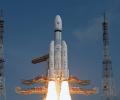
He said the test vehicle is ready at Sriharikota and the assembly work of the crew module and crew escape system has also begun.

ISRO chief's comments came after NASA said that it had found the remains of the Vikram lander by its Lunar Reconnaissance Orbiter and credited the discovery to Chennai-based amateur astronomer and engineer Shanmuga Subramanium.
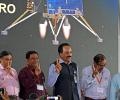
While the historic success of Chandrayaan-3 is celebrated by Indians across the world, two untrumpeted engineering colleges in Kerala are basking in the glory of the key role played by some of their alumni in the crucial Moon mission.

While the mission is a follow-up to the PSLV-C55 TeLEOS-2 mission launched in April this year, scientists in Sunday's mission will place the fourth stage of the PSLV rocket in a lower orbit.
.jpg)
The 56 and-a-half hour countdown for the launch of India's first space mission to Mars, slated for November 5, commenced on Sunday at the Satish Dhawan Space Centre in Sriharikota.

Thursday's launch is the last one of 2020 for ISRO.

Chandrayaan-3's success is a must for India's space ambitions; we can't afford to lose out. And for realising our space dreams, the Indian private sector must be encouraged because if we lose this race, the moon, Mars, and mineral-rich asteroids will already be crowded before we reach there.
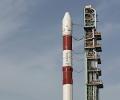
ISRO said, initially the launch was slated for 9.49 am, but now there is a 3-minute delay owing to the probability of space debris in the path of rocket.

The engine is earmarked for the LVM3-M3 mission identified for launching the next 36 OneWeb India-1 satellites, the Indian Space Research Organisation said.
